
While Andhra Pradesh is expected to receive Rs 15,000 crore to Rs 20,000 crore, Bihar is likely to get Rs 5,000 crore to Rs 10,000 crore in FY25.

The Centre has allocated Rs 73,000 crore for the rural jobs guarantee programme for 2022-23.

Given the high priority accorded to the manufacturing sector, several policy initiatives around the theme of Atmanirbhar Bharat have been set in motion to address its competitiveness and growth. Some notable examples include the PLI scheme and the employment-linked incentive scheme announced in the recent Union Budget. The Budget also announced the setting up of 12 industrial parks under the National Industrial Corridor Development Programme (NICDP).
While a DFI will help banks derisk their loan portfolios, creation of a bad bank will clean up their balance sheets.

'Inflation is not good for industry. Nor for the economy as a whole.'

The CBI had received Rs 802.19 crore initially in the last budget and it was increased to Rs 835.75 crore in the revised estimates for 2020-21.

Ahead of the Union Budget for 2023-24, Budget makers have welcomed the global consensus view that India will remain one of the bright spots in calendar year 2023. But there is some alarm over the grim global situation and how that might impact the Centre's projections and assessments for next financial year. The big global headwinds include a deep and sustained recession in the West, including India's biggest trading partners in North America and Europe, continuing volatility in commodity markets, and renewed Covid-19 fears, as lifting of strict curbs by China could potentially lead to a massive spread again.

The agency was allocated Rs 835.39 crore to manage its affairs in 2021-22 which was later increased to Rs 870.50 crore in the Revised Estimates given in the Budget document released Tuesday by Finance Minister Nirmala Sitharaman.

Supplementary provisions exceeded the original provision by as much as 239,900 per cent in 2014-15.

To enable widen the fiscal deficit beyond the permissible limit under the present legislation, the government may have to propose amendment to the FRBM Act in the Finance Bill.

The central government's fiscal deficit touched 21.2 per cent of the annual target in the June quarter as against 18.2 per cent in the year-ago period, according to official data. The fiscal deficit is the difference between total expenditure and revenue of the government. It indicates the total borrowing that are needed by the government.
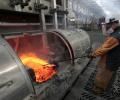
Novelis' Q3FY25 volume stood at 904,000 tonnes (down 1 per cent Y-o-Y, down 4 per cent Q-o-Q), due to lower VAP and automotive shipments. Revenue stood at $4.1 billion (+4 per cent Y-o-Y, down 5 per cent Q-o-Q).

The extra borrowing implies Jaitley will have extra spending space in the Union Budget for FY19, the last full one before the 2019 general election
This finance minister has come of age. That's not condescension. It is a praise, says Omkar Goswami.

The Union government's fiscal deficit works out to be Rs 5.47 lakh crore or 36.3 per cent of the budget estimates at the end of October 2021 on the back of improvement in revenue collection, according to the data released by the Controller General of Accounts (CGA) on Tuesday. The deficit figures in the current fiscal appear better than the previous financial year when the gap between expenditure and revenue had soared to 119.7 per cent of the last year's Budget Estimates (BE) mainly on account of a jump in expenditure to deal with the COVID-19 pandemic. In absolute terms, the fiscal deficit was Rs 5,47,026 crore at the end of October, the CGA said.

The Ministry of External Affairs (MEA) has been allocated a total of Rs 18,050 crore in the Union Budget for 2023-24 which is an increase of around 4.64 per cent over last year's allocation of Rs 17,250 crore.

'The Budget needs to focus more on social welfare schemes.'

The Centre's fiscal deficit for the first two months (April-May) of the current fiscal has increased to Rs 90,758 crore, which is 27.3 per cent of the Interim Budget estimate, according to the Controller General of Accounts data released on Tuesday. The Budget estimate for the fiscal deficit in the year 2009-10 is Rs 3,32,835 crore.
The Budget estimate for the fiscal deficit in the year 2009-10 is Rs 3,32,835 crore (Rs 3,328.35 billion). Last year 2008-09, the first two months of the fiscal had accounted for 54.9 per cent of the year's Budget estimate.

'The revenue projection arises out of all sectors doing well and the formalisation of the economy helps in making sure the tax domain gets widened.'

'We have loved Braveheart, Lord of the Rings, Game of Thrones and Apocalypto.' 'The thought was 'When are we going to do such films?''
'...to address the serious faultlines that had got exposed during the pandemic.' 'If the economy is looking up this year, we could have been allocated an increase of at least 20%.'

In absolute terms, the fiscal deficit -- the difference between expenditure and revenue -- was Rs 6.12 lakh crore during April-November 2017-18

Chief Economic Advisor V Anantha Nageswaran on Thursday said the economy is expected to grow at 6.5 per cent in the current fiscal notwithstanding deficient rains in August. India recorded economic growth of 7.8 per cent in the April-June quarter of 2023-24 against 13.1 per cent in the year-ago period. India's economy in Q1 grew at the fastest pace in a year, on the shoulders of a boost in capital expenditure both at central and state levels, along with stronger consumption demand, especially in rural areas, and improved performance in the services sector, he said.

'But can it afford to present a scenario within the existing legal framework of fiscal consolidation?', asks A K Bhattacharya.
At a combined level, the fiscal deficit of the Centre and states together will come at 12.1 per cent, with the states contributing 4.5 per cent.

More funds are expected to be allocated for the new crop insurance scheme, PMSKY and RKVY.

The net indirect tax collection in 2020-21 grew 12.3 per cent annually to Rs 10.71 lakh crore, thereby exceeding the target set in revised estimates, the Finance Ministry said on Tuesday. The mop-up through indirect taxes, which include GST, Customs and excise duties, was Rs 9.54 lakh crore in 2019-20. In the Revised Estimates (RE) for 2020-21, the target was set at Rs 9.89 lakh crore. Net collections from Goods and Services Tax (GST) stood at Rs 5.48 lakh crore during 2020-21, an eight per cent drop compared to Rs 5.99 lakh crore in the previous fiscal year.

Currently, there is no Hindu temple in Narowal district, forcing the Hindu community to perform their religious rituals at home or travel to temples in Sialkot and Lahore.

The shortfall in GST compensation payable to states in the current fiscal is estimated at Rs 2.69 lakh crore, of which Rs 1.58 lakh crore would have to be borrowed this year. The Centre expects to collect over Rs 1.11 lakh crore through cess on luxury, demerit and sin goods which will be given to the states to compensate them for the shortfall in revenue arising out of GST implementation. The remaining Rs 1.58 lakh crore would have to be borrowed to meet the promised compensation to states under the Goods and Services Tax (GST) regime.

India's economy is likely to grow by 6.5 per cent in the current and the next financial year, an EY report said, attributing lower than anticipated expansion in the September quarter to fall in private consumption expenditure and gross fixed capital formation. Real GDP growth eased to a seven-quarter low of 5.4 per cent in July-September -- the second quarter of the current 2024-25 fiscal year.

The Kumbh Mela is what it is because of the devotion of millions who make it an experience like no other. It is experiencing the heart and soul of India and the brotherhood of mankind.

The agency had received Rs 946.51 crore to manage its affairs in the Budget Estimates for 2023-24, which was later increased to Rs 968.86 crore in the Revised Estimates.
In the Union Budget for 2021-22 presented by Finance Minister Nirmala Sitharaman on Monday, the force received Rs 429.05 crore, an increase of Rs 2.78 crore (or 0.65 per cent hike) from the last budget.

Could turn out below last year's budget estimate, with some improvement in revenue and spending

But the government will present a second tranche of Supplementary Demands for Grants during the Budget session of Parliament in February, when it can seek additional spending.

The combined fertiliser, food and petroleum subsidy budgeted estimate for FY19 is Rs 2.64 trillion, while the revised estimate is Rs 2.66 trillion. If the carrying forward to FY20 does not happen, the revised estimates for the major subsidies could actually cross Rs 3 trillion for the first time ever.

The budget underscores government's previous emphasis on capex to sustain near-term recovery from the pandemic, while simultaneously paving the way for longer-term restructuring of the economy, it stated. But the various spending initiatives are not offset by any significant announcements related to further increase revenue generation; rather, the announced revenue-related measures are aimed at other objectives such as fostering startup innovation, ensuring more equitable treatment for cooperatives and state employees, and promoting tax compliance through simplification, Christian de Guzman, a senior vice-president, sovereign risk group, Moody's Investors Service, said.

The Centre is grappling with the question of its fiscal roadmap not only for this year but for 2018-19

The year 2024 was the hottest year on record, with the global average temperature exceeding 1.5 degrees Celsius above pre-industrial levels for the first time, according to the European climate agency Copernicus. Every month from January to June was the warmest ever recorded, and from July to December (except August), each month was the second warmest on record. Scientists are warning that the world is entering a new climate reality, with extreme heatwaves, floods, and storms becoming more frequent and severe. The report also highlights the failure of developed nations to meet their climate finance commitments to developing countries, despite the urgency of the situation.
